Key takeaways
- The maths gives it away: a $25 package of 50 links works out at 50 cents a link, while surveys of link sellers put the average paid link at about $83.
- Usually wasted, sometimes worse: Google's systems mostly ignore links bought to boost rankings, and a manual action for unnatural links is the rarer, more expensive outcome.
- "White hat" doesn't fit: Google's spam policies class buying links for ranking as link spam, so a paid dofollow link can't be white hat whatever the listing says.
- Scores aren't rankings: DA, DR and PA are third-party estimates that Google doesn't use, and a high score on a platform anyone can post on says nothing about the page your link sits on.
- One question settles it: would the site still link to you if nobody paid its owner? If not, it's a bought link.
A $25 backlink package isn't a budget version of link building. It's a different product. Link building gets your brand onto sites your buyers read. A cheap package gets you a spreadsheet of URLs.
If you've seen gigs promising 50 "high DA, white hat" links for the price of lunch, you've probably wondered whether they work, and how they can be so cheap. The short answer is that most of that money is wasted, and some of it can cost far more to undo.
Below, I go through four real Fiverr listings and test each claim against Google's own policy. Then I show you how to check any link offer before you pay. I didn't buy these gigs, so I can't tell you what any one seller delivers. I read the listings and checked each claim against Google's published guidance and public data.
What cheap backlinks are, and where they're sold
Cheap backlinks are links sold in bulk at a price per link that no owner of a real, read site would accept. Most are sold by freelancers on marketplaces such as Fiverr, in packages of anywhere from 20 to several thousand links for under $100.
The Fiverr search I ran on 21 October 2026 returned 4,681 services. The wording varies, but most packages are built from the same handful of link types.
| Link type | What it is | Does it help rankings? |
|---|---|---|
| Blog comments | A link in the comments under someone else's post, often posted by software | Rarely. Most comment links carry nofollow or ugc, which blocks ranking credit |
| Web 2.0 posts | Posts on free platforms such as Blogger or WordPress.com, created to host links | Very little. The page has no readers and no links of its own |
| Profiles and directories | Sign-up profiles on forums and social sites, or listings in low-quality directories | Very little. Google names low-quality directory links as link spam |
| PBN posts | Posts on a private blog network: sites one seller owns and keeps only to sell links | Short term at best, until the network is detected and ignored |
| Paid guest posts | An article on a site that publishes anything for a fee | Weak. Every other link on that site is for sale too |
None of these is new. What changed is how well Google spots them, which is why the claims on the listings have become louder.
Fiverr backlinks: four listings, decoded
Here are four gigs from the first row of that search. Between them they show thousands of reviews and ratings of 4.9 or 5.0.
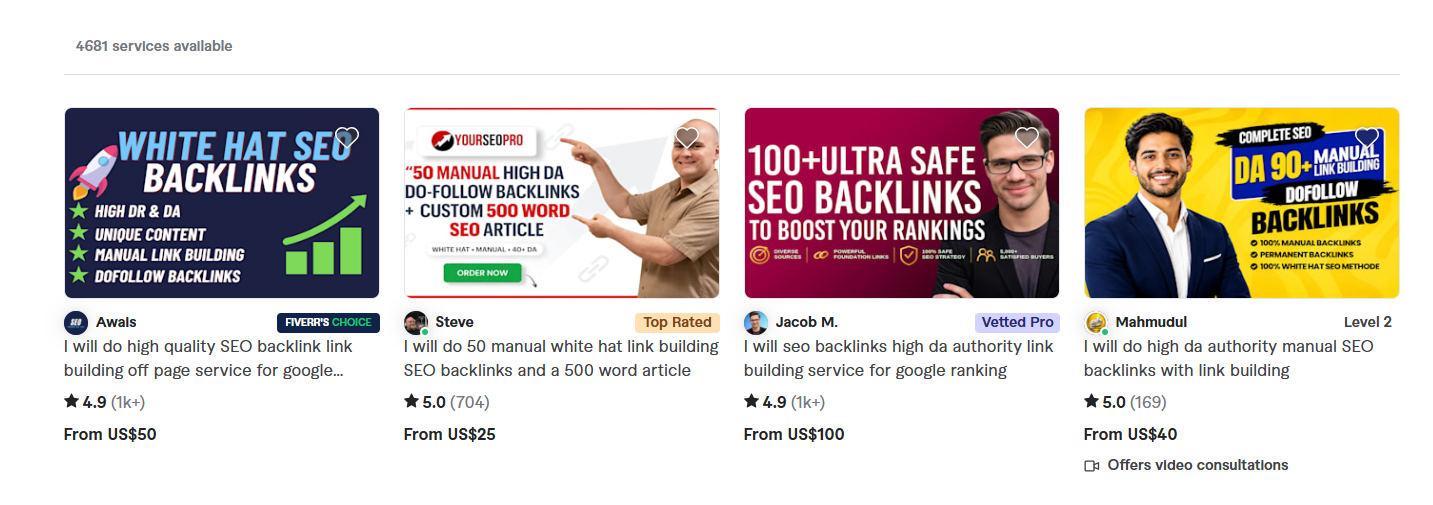
| From | What the listing promises | What that usually means |
|---|---|---|
| $25 | 50 manual, high-DA, dofollow links plus a 500-word article | 50 cents a link. At that price, the links come from pages the seller can create in minutes |
| $40 | DA 90+, dofollow, permanent, 100% white hat | DA 90+ domains are mostly big platforms where anyone can open an account. Nobody can promise a link there is permanent |
| $50 | High DR and DA, unique content, manual link building | "Manual" describes how the links are made, not where they sit. A high domain score says nothing about the page |
| $100 | 100+ "ultra safe" links, 5,000+ satisfied buyers | About $1 a link. "Safe" can't describe a paid dofollow link sold to boost rankings |
Why 4.9 stars doesn't mean the links work
Gig reviews measure delivery. The buyer gets a report within days and rates the seller then. Rankings, if they move at all, move weeks or months later, long after the review is written. A five-star review tells you the spreadsheet arrived on time.
The "white hat" contradiction
The first example of link spam in Google's spam policies is "buying or selling links for ranking purposes". A paid link only stays within the rules if it's marked rel="sponsored" or rel="nofollow", and that marking removes the ranking credit you were paying for. So a paid dofollow link sold to lift rankings is link spam by Google's own definition. Calling it white hat doesn't change what it is.
DA, DR and PR: the backlink metrics sellers use
Cheap packages sell on third-party scores because those scores are easy to move and easy to screenshot. None of them is a Google metric.
- DA and PA: Domain Authority and Page Authority are Moz's estimates of how well a site or page might rank. Domain Rating (DR) is Ahrefs' equivalent. They're handy for comparing sites, but a seller who picks sites by the number alone is optimising for your report, not your rankings.
- Borrowed scores: a new profile or subdomain on a DA 90+ platform shows the domain's number, yet the page itself has no links pointing to it and no one reading it.
- PR: PageRank still exists inside Google, but Google stopped publishing PageRank scores in its toolbar in April 2016. Any "high PR" promise today is a number nobody outside Google can check.
The before-and-after screenshots that come with many packages usually show these scores rising. Notice what they leave out: rankings for the keywords you care about, and the enquiries those rankings should bring.
Are cheap backlinks safe? What Google's spam policy says
Usually they're less dangerous than useless. Google's systems are built to spot links made to manipulate rankings and stop them counting. When that happens, Google's spam updates page says any ranking benefit those links gave you is lost, and that after a link spam update, "making changes might not generate an improvement".
Cyrus Shepard, an SEO consultant who has studied Google's leaked ranking documents, puts it in five words: "Google actually ignores most of them." That matches what Google says itself. Ignored is far more common than punished.
The rarer outcome is a manual action. A Google reviewer flags unnatural links pointing to your site, and some pages or the whole site can drop out of the results. It shows up in the Manual Actions report in Search Console, and lifting it means removing or disavowing the links and asking Google to review the site again. That's weeks of work to undo a $40 purchase.
| Outcome | How often | What it costs you |
|---|---|---|
| Links ignored | The most likely outcome | The fee, plus the months you spent waiting for results |
| Short lift, then a drop | Possible with network links, until the network is caught | The lift, plus time spent working out why rankings fell |
| Manual action | Less common, more likely with large and obvious patterns | Lost visibility until you clean up and Google reviews the site |
Cheap links don't help with AI answers either. AI assistants tend to cite pages that already rank well and brands that people mention on sites they read. A comment on an abandoned blog does neither. If AI visibility is the goal, my guide on how to get your brand cited in AI answers covers what does move it.
How much a backlink costs when it's real
A link that helps is one a real site gives you because your page is worth linking to. You can't buy that directly. You can pay for the work that earns it, which is mostly a page worth citing and pitches to the editors who'd cite it.
For scale, look at the market for paid links on real sites, which still breaks Google's rules but at least involves owners who value their pages. In its guide to whether you should buy backlinks, Ahrefs cites Authority Hacker's survey of 755 link builders, which put the average paid link at $83. Ahrefs' own outreach to 450 sites found an average of $361.44 to add a link to an existing article, and only 12.6% of those sites would sell at all.
A $25 Fiverr link costs under 1% of an average paid link
Price per link in US dollars, scale from zero. Fiverr figures are starting price divided by links promised.
Sources: Fiverr listings, 21 Oct 2026. Ahrefs, Should You Buy Backlinks? (updated July 2024), citing Authority Hacker's survey and Ahrefs' outreach to 450 sites.
Those survey figures are a couple of years old, but the gap is too wide for age to matter. If a link costs 50 cents, nobody is paying the site's owner, which tells you who controls the site.
How to check a backlink offer before you pay
Run any link offer, from a gig or an agency, through these checks. A seller who can't answer them clearly is selling the report, not the links.
- Ask for the site list first: a seller with real placements can name the sites. A "private list" usually means a network.
- Check the sites get traffic: in Ahrefs or Semrush, a high domain score with almost no organic traffic is a warning sign.
- Check the fit: would your buyers read this site? A Bangkok clinic gains nothing from a link on a crypto blog written in another language.
- Ask how each link is placed: if the seller owns the site or pays its owner, it's a bought link, however the listing describes it.
- Ask what gets reported: a useful report shows how rankings and enquiries moved for the pages that were linked to. Domain scores alone don't count.
If you'd like to know what a ranking is worth before you spend anything on links, the SEO ROI calculator puts a rough figure on it.
Link building services that earn links instead
This is the work I do at Wincon. We don't buy links, use private blog networks or run link exchanges. Links come from outreach to relevant sites, digital PR built on data, and guest articles and expert quotes on sites people actually read. Every link we win is reported with the page it sits on and why it matters.
It's slower and costs more per link than any gig above. link building is a channel in our monthly levels, with 3 to 6 backlinks a month depending on the level; the terms are on the pricing page. That's far fewer links than a $25 gig promises, on purpose. A handful of links from sites your buyers trust is usually worth more than hundreds from sites nobody visits. You can see how it works on the link building service page.
FAQs
Are Fiverr backlinks safe?
Most aren't worth the risk. A typical Fiverr backlink gig sells dofollow links placed to boost rankings, which Google's spam policies class as link spam. The usual outcome is that Google ignores those links, so you've paid for nothing. The worse outcome is a manual action for unnatural links, which can push some or all of your pages out of the results until you clean up. A gig that delivers dozens of links for under $100 can't be paying the owners of real sites.
Can cheap backlinks get my site penalised?
They can, but it's less common than people fear. Google's systems mostly neutralise spammy links rather than punish the site they point to, so the links simply stop counting. Manual actions still happen when a reviewer finds a clear pattern of bought or manipulative links. Either way, any ranking boost those links gave you disappears, and Google says that after a link spam update, making changes might not bring an improvement.
How much does a good backlink cost?
There's no fixed price, because good links are earned rather than bought. What you pay for is the work: research, content worth citing and outreach to real sites. For scale, Ahrefs cites a survey of 755 link builders that put the average paid link at $83, and paid links still break Google's rules. A package charging 50 cents a link tells you the site owner isn't being paid at all.
Is paying for link building the same as buying links?
No. Paying an agency or freelancer for research, content and outreach is normal marketing work. Buying links means paying for a link that passes ranking credit, which breaks Google's spam policies unless the link is marked rel="sponsored" or rel="nofollow". The test is simple: would the site still link to you if nobody paid its owner? If not, it's a bought link, whatever the gig calls it.
Do blog comment backlinks still work?
Not for rankings. Google recommends that sites mark comment and forum links with rel="ugc", and most blog platforms add nofollow to comment links by default, so they pass little or no ranking credit. Google's spam policies also list forum comments with optimised links as link spam. A comment can still earn a click if it adds something useful to a discussion your buyers read, but that's community work, not link building.

Guy founded Wincon Marketing in Bangkok after nearly ten years in SEO, content and paid media, both agency-side and in-house. He moved early into AEO as AI assistants started answering buyers' questions, and now helps brands get found on Google and in AI answers.
Connect on LinkedIn →